
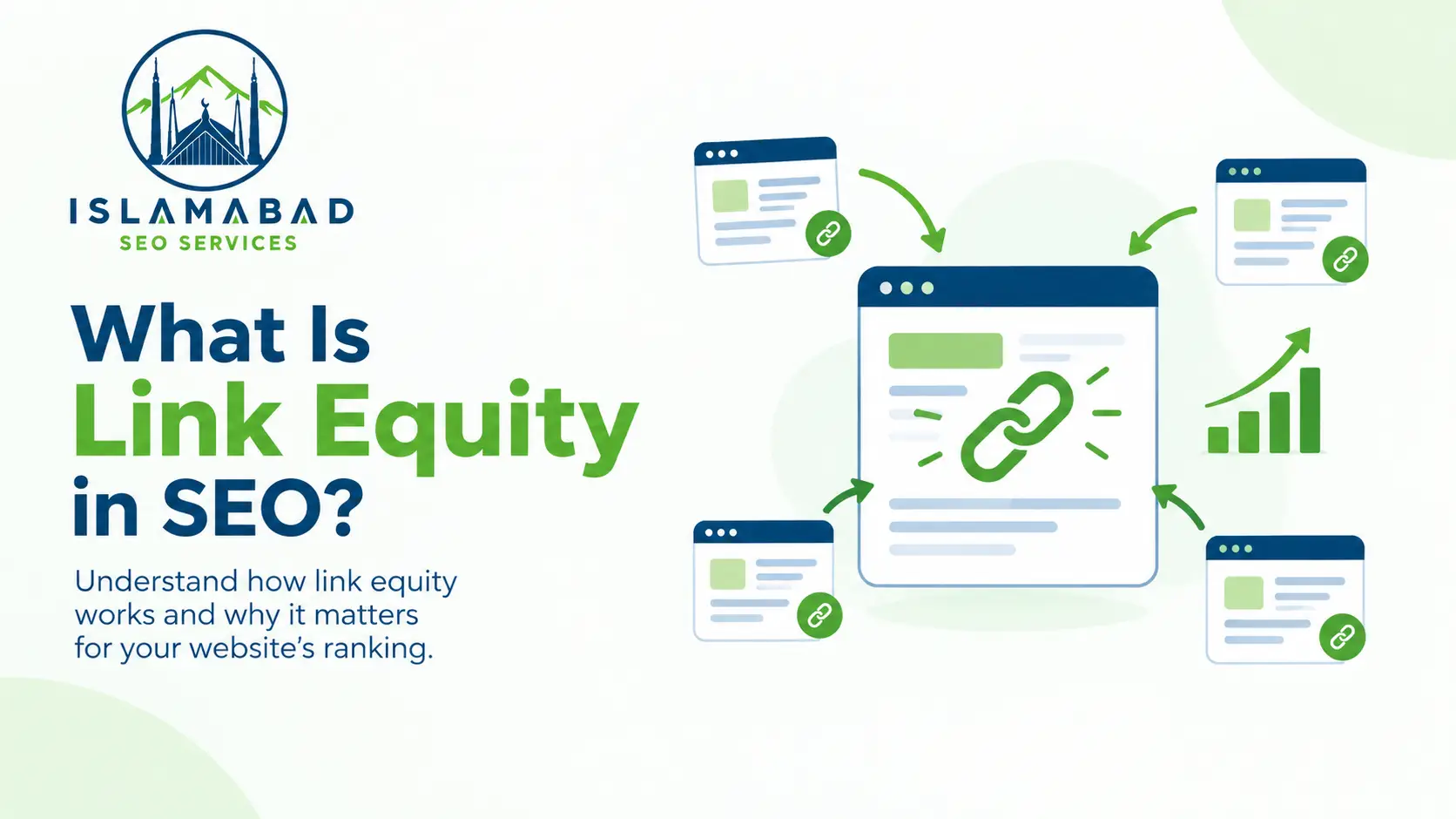
Link equity in SEO is the value and authority that one webpage can pass to another through a hyperlink. Search engines use links as signals when evaluating relationships, relevance, authority, and page importance. Link equity comes from both external backlinks and internal links, although the signals and context differ.
For a business targeting competitive search results, understanding link equity helps you build stronger pages, improve information architecture, and allocate internal authority toward URLs that matter. Islamabad SEO Services uses this principle when planning link building and internal linking strategies for websites that need clearer topical relationships and stronger organic visibility.
What Is Link Equity?
Link equity is the SEO value associated with a link from one page to another. The value can reflect characteristics of the linking page, the destination page, the relationship between both pages, and how search engines interpret the link.
The term link juice is an older, informal expression for link equity. Link equity is not a visible Google metric with a fixed numerical score that you can inspect in Search Console. SEO platforms may provide proprietary measurements such as URL Rating, Domain Rating, or Page Authority, but those measurements are not Google link-equity scores.
A followed hyperlink can contribute to the destination page’s ability to perform in search results when the link is crawlable, relevant, and useful. A backlink from another website can provide external signals, while an internal link can help search engines discover and understand important pages within your own site.

How Does Link Equity Work?
Link equity works through the signals associated with linking relationships between pages. A page that earns valuable backlinks can accumulate authority signals, and internal links can help search engines understand how that authority relates to other pages.
The process starts when a page receives links from other crawlable pages. Search engines evaluate the linking page and the link itself rather than treating every hyperlink as equal. A relevant editorial link from a page with strong signals can carry different SEO value from a low-quality, unrelated, or manipulative link.
The destination page matters too. A link does not automatically make a weak page authoritative. Search engines evaluate content quality, relevance, intent, accessibility, and other ranking signals alongside links.
How Is Link Equity Determined?
Link equity is determined by multiple link and page characteristics rather than by one fixed formula. Important factors include authority, topical relevance, crawlability, link attributes, placement, destination status, and the overall quality of the linking environment.
Authority of the Linking Page
A link from a page with stronger authority signals can carry more SEO value than a comparable link from a weak page. Authority is influenced by the page’s own backlink profile and other search-engine signals.
Third-party metrics such as Domain Authority can help you compare URLs or domains during an audit, but these metrics are estimates created by SEO tools rather than Google ranking scores.
Topical Relevance
Topical relevance helps search engines interpret why a link exists and whether the destination relates to the surrounding content. A contextual link from a page about technical SEO to a detailed SEO audit guide has a clearer topical relationship than a random link from an unrelated subject.
Relevance does not require identical keywords. Semantic SEO helps search engines understand closely connected entities, concepts, services, and user needs.
Link Attributes
A followed link can pass ranking signals, while rel=”nofollow” tells search engines not to associate the link with the same endorsement in the normal way. Google treats nofollow as a hint for crawling and ranking rather than as a guaranteed command in every situation.
Sponsored and user-generated links have specific attributes too. Use rel=”sponsored” for paid placements and rel=”ugc” for qualifying user-generated content.
Crawlability and Accessibility
A search engine must be able to access the relevant pages and links before link signals can contribute effectively. Robots.txt rules, authentication barriers, rendering problems, and other technical restrictions can interfere with discovery or processing.
A link pointing to an inaccessible destination cannot provide the same practical SEO benefit as a crawlable, indexable destination.
Link Placement and Context
Contextual links within meaningful page content provide clearer relevance signals than links placed without useful surrounding context. Placement can affect how users interact with a link and can help search engines interpret the relationship between the source and destination.
Do not treat footer, sidebar, navigation, or body links as automatically valuable or worthless. Evaluate placement according to page purpose, user intent, accessibility, and site architecture.
Outbound Link Distribution
The number and quality of outbound links can affect how a page distributes its available linking signals. A page that links to hundreds of unrelated destinations creates a different linking environment from a focused page with a small set of highly relevant references.
Avoid simplistic formulas that divide a page’s authority by its exact number of outbound links. Modern search systems use complex ranking systems, so link equity cannot be calculated accurately with a basic arithmetic equation.
Link Equity and PageRank in SEO
PageRank is Google’s historical link-analysis system, while link equity is a broader SEO concept used to describe value associated with links. PageRank helped establish the importance of links as authority signals, but modern Google ranking systems use many signals beyond link relationships.
PageRank should therefore not be treated as a public page score that you can directly optimize. Modern SEO requires attention to content, relevance, technical accessibility, user needs, links, and other ranking systems.
PageRank sculpting attempted to control internal authority distribution by selectively manipulating followed and nofollow links. Current SEO practice should focus on useful information architecture instead of trying to engineer a precise PageRank flow with nofollow.
Internal Linking and Link Equity
Internal linking helps distribute contextual authority and discovery signals across pages on the same website. Strong internal linking connects important pages with relevant supporting content, helping build topical authority and giving search engines clearer information about site structure.
A practical internal linking system should connect service pages, category pages, guides, supporting articles, and related resources where the relationship is genuinely useful. Strong pages can link to priority URLs, while priority URLs should receive enough relevant internal references to remain discoverable and contextually connected.
Anchor text should describe the destination accurately. Use natural descriptive phrases instead of repeating an exact keyword across every internal link.

External Links and Link Equity
External backlinks can contribute valuable authority and relevance signals when reputable websites link to your content for legitimate editorial reasons. A strong backlink profile usually comes from useful content, genuine relationships, digital PR, industry resources, citations, and other methods that earn relevant references.
Link building should prioritize relevance and quality over raw backlink volume. Guest posting, resource outreach, broken-link opportunities, original research, expert contributions, and useful tools can support legitimate link acquisition when the resulting links serve a real editorial purpose.
Paid links intended to manipulate rankings can create search-policy risks. Avoid link schemes, automated backlink generation, excessive reciprocal linking, and low-quality placements created mainly to influence rankings.
How to Maximize Link Equity
To maximize link equity, strengthen the pages that earn links and create an internal structure that connects earned authority with your most important URLs. Use a repeatable process rather than chasing isolated backlink metrics.
Start with a backlink audit. Identify pages that attract authoritative and relevant external links, then assess whether those pages link naturally to important commercial or informational destinations.
Next, review internal linking. Find valuable pages with few internal links, identify relevant source pages, and add contextual links where the destination helps users complete their search journey.
Then review technical conditions. Fix broken internal links, redirect chains, orphan pages, incorrect canonical signals, blocked URLs, and important pages that lack crawlable paths.
Finally, strengthen link-worthy content. Original research, detailed guides, proprietary data, expert insights, and genuinely helpful tools give other websites stronger reasons to reference your pages.
Common Link Equity Mistakes
The most common link equity mistakes involve treating every backlink as equal, manipulating link attributes, or ignoring internal architecture. Five problems deserve particular attention.
- Buying large volumes of low-quality links can create an unnatural backlink profile and expose a site to search-engine policy risks.
- Using exact-match anchor text excessively can make internal or external linking appear unnatural.
- Leaving important pages orphaned prevents strong internal relationships from supporting discovery and relevance.
- Redirecting valuable URLs through unnecessary chains creates avoidable technical complexity.
- Measuring SEO progress only through third-party authority metrics ignores content quality, relevance, indexing, and actual organic performance.
A sound strategy evaluates links as part of the complete website rather than as isolated numerical assets.
How to Audit Link Equity
A link-equity audit identifies where valuable links originate, where internal signals flow, and where technical problems interrupt important relationships. Review the site in four stages.
First, export backlinks and examine referring domains, linking pages, anchor text, relevance, destination URLs, and link attributes. Separate genuinely useful links from irrelevant or suspicious patterns.
Second, crawl internal links with an SEO crawler. Check orphan URLs, broken links, redirecting links, excessive click depth, duplicate anchors, and pages that receive little internal support.
Third, inspect priority URLs through a technical SEO audit for indexability, canonicalization, HTTP status, robots.txt access, and rendering. A strong backlink cannot compensate for a destination that search engines cannot properly process.
Fourth, compare link signals with organic performance. Pages that receive strong links but underperform may need better search intent alignment, content depth, internal context, technical accessibility, or page-level optimization.
Link Equity vs. Link Authority
Link equity describes the value associated with a linking relationship, while link authority usually describes the perceived strength of a page, URL, or domain. SEO tools often use authority terminology for proprietary metrics, but Google does not publish a link-authority score for webpages.
The distinction matters during audits. A page can have strong authority signals but provide limited value to a destination when topical relevance is weak or the link is not processed as an endorsement. Review the linking relationship instead of relying on one third-party metric.
Redirects and Link Equity
Permanent redirects can consolidate signals from an old URL to a new URL when the redirect correctly represents a permanent move. A 301 redirect is commonly used during URL migrations, content consolidation, and domain changes.
Temporary 302 redirects communicate a different status and should match temporary moves. Do not create redirect chains or loops. Map old URLs directly to relevant current destinations, preserve useful content, and update internal links after migration.

A Practical Link Equity Strategy
A strategy connects earned backlinks, internal linking, relevant content, and technical accessibility into one system. Start by identifying pages that attract backlinks, then connect those pages to related priority URLs through contextual internal links.
Map each important URL to supporting topics and commercial destinations. Review anchor text for clarity, monitor newly acquired backlinks, and check whether priority pages remain crawlable and indexable. Reassess the structure after major content launches, migrations, or URL changes.
Frequently Asked Questions
What is link equity in SEO?
Link equity in SEO is the value and authority associated with a hyperlink from one webpage to another. Link equity depends on factors such as source quality, topical relevance, link attributes, crawlability, context, and the relationship between linked pages.
How does link equity affect SEO rankings?
Link equity can support SEO rankings by providing authority, relevance, and discovery signals through links. Search engines evaluate these signals alongside content quality, search intent, technical accessibility, and other ranking factors when determining how pages appear in search results.
How is link equity passed between web pages?
Link equity can pass through crawlable links from one page to another, subject to search engine interpretation of the link and surrounding context. Internal links distribute signals within a website, while backlinks can provide external authority and relevance signals.
How do internal links help distribute link equity?
Internal links help distribute link equity by connecting pages within the same website and directing contextual signals toward relevant destinations. A logical site structure lets important pages receive appropriate internal references while helping crawlers discover relationships, content depth, and priority URLs.