Search engines have changed the way they evaluate websites. Ranking is no longer about placing a keyword on a page as many times as possible. Search engines now consider context, relevance, content quality, and how well a website covers a subject.
This makes topical authority an important part of modern SEO. A website develops topical authority when it consistently publishes useful and trustworthy information around a particular subject.
Instead of creating isolated articles for individual keywords, the goal is to build a connected collection of content that answers related questions and demonstrates genuine knowledge.
What Is Topical Authority in SEO?
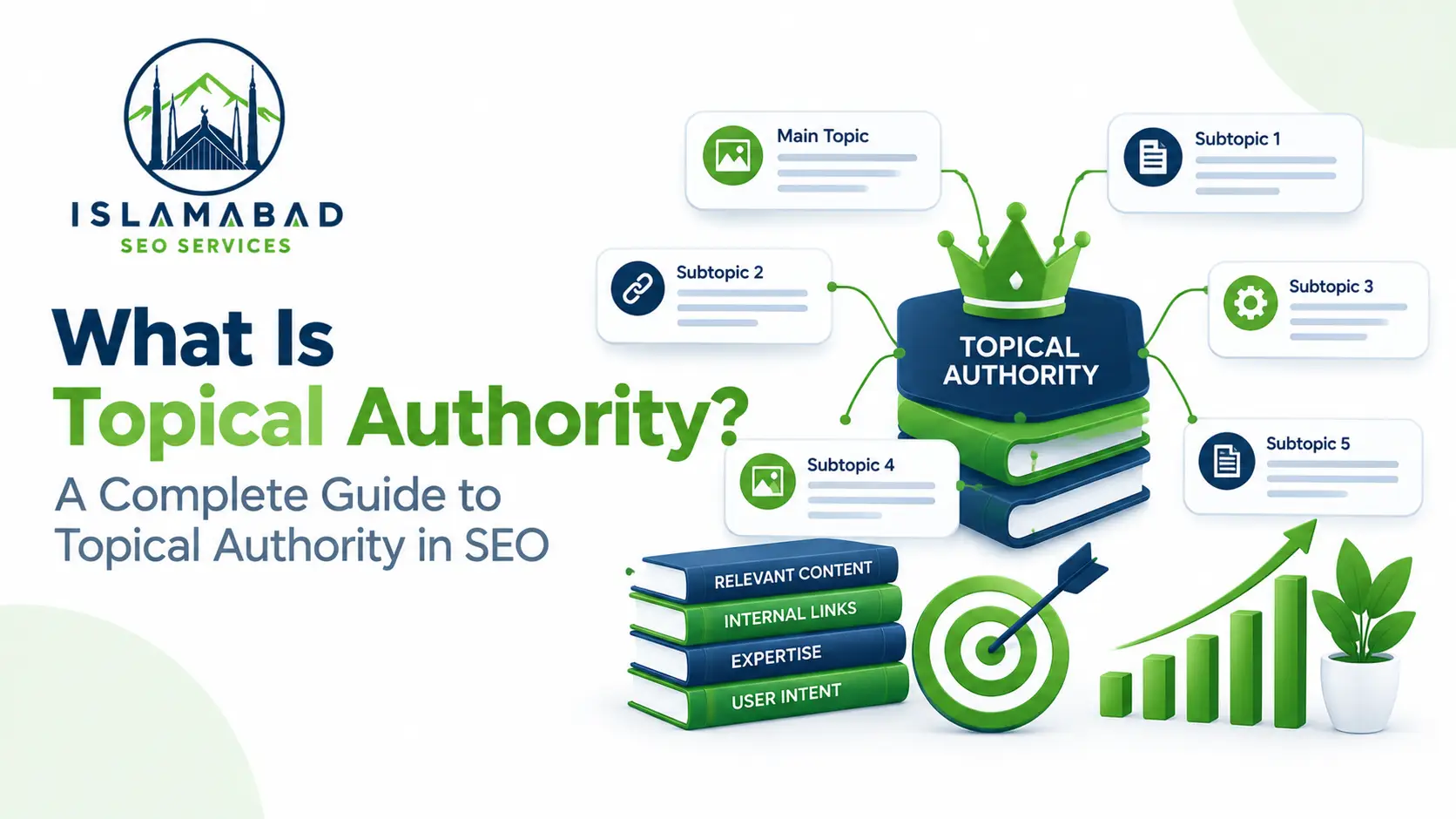
Topical authority is the level of expertise, relevance, and credibility a website demonstrates about a specific topic.
For example, an SEO website that covers keyword research, technical SEO, content optimisation, search intent, internal linking, and link building has broader topical coverage than one that publishes only a few general SEO articles.
Topical authority is also different from domain authority. Domain authority is a third-party SEO metric associated mainly with a site’s overall backlink strength, while topical authority relates to expertise and relevance within a particular subject.
How Does Topical Authority Work?
Search engines use different signals to understand how relevant and useful a website is for a topic. Well-organised and connected content helps establish that relevance.
Topic Depth and Overall Coverage
Strong topical coverage means discussing a subject from multiple relevant angles. For an SEO website, this could include technical SEO, keyword research, local SEO, on-page optimisation, content strategy, search intent, and link building.
Covering these connected areas gives search engines more context about your expertise while providing users with more complete resources.
Topic Clusters and Semantic Relevance
Topic clusters organise related pages around a central subject. A pillar page introduces the main topic, while supporting articles cover specific questions or subtopics.
Internal links connect these pages and make their relationships clearer. Semantic relevance also helps search engines understand related concepts beyond exact keyword matches.
E-E-A-T and Demonstrated Expertise
E-E-A-T stands for Experience, Expertise, Authoritativeness, and Trustworthiness. It is not a specific ranking score but provides useful principles for creating credible content.
Firsthand experience, accurate information, expert contributions, reliable sources, and transparent authorship can strengthen trust.
Why Is Topical Authority Important?
Topical authority can support stronger SEO performance in several ways.
Grow Search Rankings and Organic Traffic
Comprehensive topic coverage can make your website relevant for more searches. A well-planned content cluster may rank for the main topic, related questions, variations, and long-tail searches, increasing organic visibility and attracting relevant visitors.
Strengthen Website Trust and Credibility
Consistently providing useful information can establish your brand as a knowledgeable source. When users repeatedly find your website while researching related subjects, they may become more familiar with and confident in your brand.
Gain Relevant Backlinks
Valuable content can naturally attract links from other websites. Detailed guides, original research, expert commentary, statistics, and useful resources may be referenced by industry publishers.
Relevant backlinks can support SEO, but quality matters more than simply collecting large numbers of links.
Increase Visibility in AI Search
Topical authority can also support visibility in AI-powered search. AI systems need relevant and trustworthy information when generating responses.
Websites with clear, comprehensive, and well-structured content may have more opportunities to be referenced in AI-generated answers.
How Do Search Engines Determine Topical Authority?
There is no single public Google score for topical authority. Instead, search systems evaluate different signals related to relevance, quality, context, and user needs.
Semantic Search and User Intent
Search engines increasingly focus on the meaning behind a query. Your content should therefore answer the reason behind a search rather than simply repeat a keyword.
For example, someone searching for “how to build topical authority” expects practical advice. A useful page should explain the process, not just provide a definition.
Google’s Shift Toward Understanding Context
Google has progressively improved its ability to understand language and context. Hummingbird helped interpret search meaning, RankBrain introduced machine learning into query interpretation, and BERT improved the understanding of words within context.
These developments have made meaning and intent increasingly important in search.
Helpful Content and E-E-A-T Signals
Search engines aim to surface content that genuinely helps people. Pages created mainly to manipulate rankings may provide less value than content designed to answer questions and solve problems.
Demonstrating experience, expertise, and trustworthy information can make your content more useful.
How to Build Topical Authority for Your Website
Building topical authority requires a focused content strategy rather than publishing articles randomly.
Focus on a Specific Niche
Choose a subject closely related to your business and expertise. A focused niche makes it easier to create meaningful connections between pages and develop deeper knowledge.
Covering too many unrelated subjects can make your content strategy scattered.
Research Related Keywords and Topics
Identify related keywords, questions, subtopics, entities, and search intents around your main subject.
Competitor research can reveal topics your website is missing. Tools such as Ahrefs, Semrush, and Ubersuggest can also help identify keyword opportunities and content gaps.
Build Pillar and Supporting Content
Create a detailed pillar page for an important topic and support it with more specific articles.
For example, an SEO pillar page could connect to content about keyword research, technical SEO, internal linking, and search intent. This creates a logical structure for users and search engines.
Publish Useful and In-Depth Content
Comprehensive content does not mean making every article unnecessarily long.
Answer relevant questions, explain concepts clearly, use accurate information, and provide useful examples. Every page should have a clear purpose and offer genuine value.
Improve Internal Linking
Internal links connect related pages across your website. Link supporting articles to relevant pillar pages and connect closely related subtopics where appropriate. XML sitemaps can complement this structure by helping search engines discover important URLs on your website.
Descriptive anchor text can also help readers understand where each link leads.
Earn Relevant Backlinks
Focus on obtaining backlinks from credible and relevant websites.
Original research, digital PR, expert contributions, useful resources, and genuine brand mentions can attract quality links. Relevant links are generally more valuable than large numbers of unrelated links.
Add Expert Knowledge and Firsthand Experience
Genuine knowledge and practical experience can make content more useful.
Where appropriate, include case studies, original examples, expert opinions, practical observations, and subject matter expert insights. Clear authorship can also improve transparency.
Update Existing Content Regularly
Topical authority requires ongoing maintenance. Facts, statistics, tools, and industry practices can change.
Review important pages regularly, update outdated information, and use content gap research to discover new subtopics for your content clusters.
How to Measure Your Topical Authority
Since there is no universal topical authority score, evaluate several SEO indicators together.
Monitor Keyword Rankings and Topic Coverage
Track the keywords your website ranks for and whether visibility is expanding across related topics. Growth across relevant searches can indicate broader topical coverage.
Review Internal Links and Backlinks
Check whether related pages are properly connected through internal links. Also monitor whether your content is earning backlinks from relevant and trustworthy websites.
Track Organic Search Growth
Organic traffic can provide another useful indicator. If your website receives traffic from a broader range of searches related to your subject, your topical coverage may be improving.
Monitor AI and LLM Citations
Mentions and citations in AI-powered search platforms can provide an additional visibility signal. However, they should not be treated as a definitive measure because there is no universal AI authority metric.
Topical Authority Mistakes to Avoid
Common mistakes that can weaken your topical strategy include:
- Publishing unrelated articles
- Creating thin content to target keywords
- Ignoring search intent
- Focusing only on high search volume
- Prioritising quantity over quality
- Building irrelevant backlinks
- Failing to connect related pages
- Leaving important content outdated
More content does not automatically create topical authority. Every page should contribute useful information to the wider subject.
How Long Does It Take to Build Topical Authority?
There is no fixed timeframe for building topical authority.
A new website may need several months of consistent content creation, optimisation, internal linking, and link building before meaningful improvements appear.
The timeline depends on competition, niche complexity, website history, content quality, and how thoroughly competitors cover the subject.
Consistency is key. Authority develops as your website builds a larger collection of useful, connected, and trustworthy resources.
Conclusion
Topical authority is about establishing your website as a reliable source within a specific subject.
Rather than creating isolated pages for individual keywords, build a connected content ecosystem that covers important topics, answers user questions, and demonstrates genuine expertise.
Choose a focused niche, research related topics, create pillar and supporting content, strengthen internal links, earn relevant backlinks, and keep information updated. Islamabad SEO Services can help businesses develop a structured SEO strategy around their target topics and search goals.
The goal is not simply to rank for more keywords. It is to become a genuinely useful resource that users and search engines can trust.
Frequently Asked Questions
How can you build topical authority?
Choose a focused niche, research related topics and search intent, create useful pillar and supporting content, connect pages through internal links, earn relevant backlinks, and demonstrate real expertise.
Is topical authority different from domain authority?
Yes. Topical authority relates to your expertise and relevance within a particular subject. Domain authority is a third-party metric that generally reflects a website’s overall link strength.
Can backlinks improve topical authority?
Relevant, high-quality backlinks can support credibility and SEO performance. However, backlinks alone do not establish topical authority. Content depth, relevance, internal linking, and expertise also play important roles.
Does topical authority help with AI search?
It can. Well-structured, comprehensive, and trustworthy content may have a better chance of being referenced by AI-powered search systems, although there is no guaranteed AI citation or universal authority score.