SEO glossary pages define important industry terms while creating organized opportunities for organic search visibility, internal linking, user education, and topical coverage. Each glossary entry can address a specific search query, explain a concept clearly, connect related subjects, and guide readers toward detailed resources or relevant services.
The objective is not to create a large collection of short definitions. A useful glossary must satisfy genuine search intent, provide accurate information, strengthen website architecture, and avoid thin content or keyword cannibalization. For Islamabad SEO Services, a structured glossary can become a practical resource that supports both users and the wider content strategy.
What Is an SEO Glossary Page?
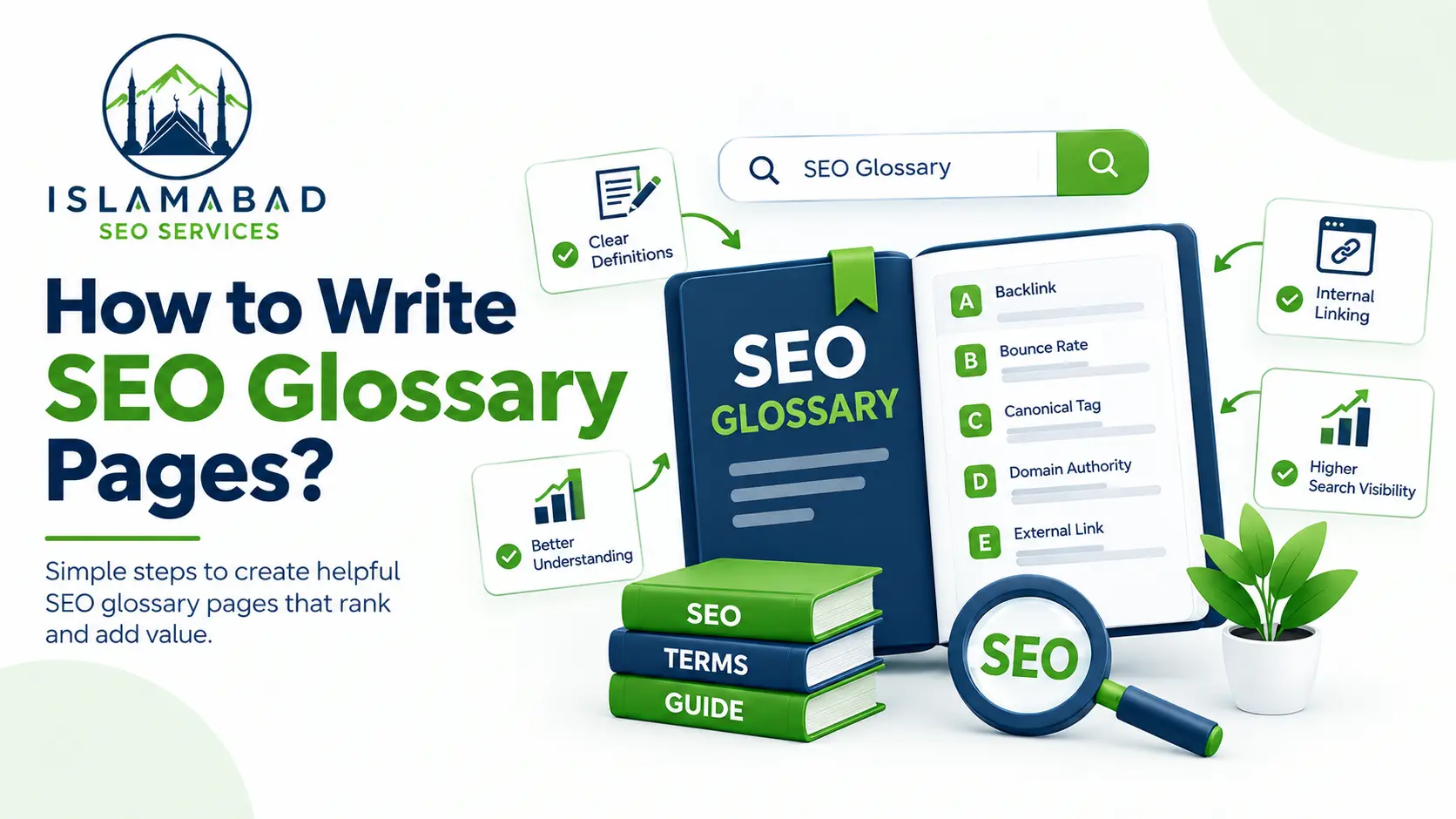
An SEO glossary page is an organized resource that explains terms associated with a particular industry, subject, or service. A glossary can use one comprehensive page, a central index connected to individual entries, or a combination of both structures.
A glossary hub normally provides concise definitions and directs users toward detailed resources when a term requires broader explanation. A standalone glossary entry makes sense when a topic has distinct search intent, meaningful user demand, and sufficient depth to justify an independent page.
Alphabetical navigation helps visitors locate familiar terms quickly. Semantic categories can provide another navigation layer by grouping concepts that belong to related subject areas.

Why Are SEO Glossary Pages Important?
SEO glossary pages address definition-focused searches while creating a structured resource for internal linking and topical education. A well-planned glossary can support several objectives across your website:
- Explain technical terminology in accessible language.
- Target relevant informational search queries.
- Connect related pages through contextual internal links.
- Expand topical coverage around important concepts and entities.
- Move users from definitions toward guides, products, or services.
Search engines assess relevance, usefulness, accessibility, content quality, links, and other signals. A glossary provides genuine SEO value when individual entries answer real questions and contribute to a logical website structure.
A glossary should therefore form part of your broader content strategy rather than operate as a separate collection of definitions with no relationship to other pages.
How Do You Select Terms for an SEO Glossary?
To select glossary terms, examine customer questions, industry vocabulary, existing website content, and keyword research. Create a broad candidate list before deciding which terms deserve individual entries.
Include definitions, abbreviations, processes, problems, metrics, and concepts that your audience needs to understand. For example, a business glossary may include terms related to local SEO when geographic search is relevant to its audience
Cluster queries according to meaning and search intent. For example, “organic traffic,” “organic search traffic,” and “what is organic traffic” can represent one topic rather than three separate pages.
Check existing website rankings before creating a URL. An existing article that already satisfies the intended search can receive further optimization instead of competing with a new glossary entry. This approach reduces cannibalization and concentrates authority around the most appropriate page.
How Do You Choose Which Glossary Terms to Publish?
Prioritize terms according to search demand, business relevance, competition, existing coverage, and user importance. Begin with subjects that combine meaningful demand with realistic opportunities for useful coverage.
Important industry concepts can deserve inclusion even when competition is high because comprehensive coverage can support user education and topical depth.
Create a content plan for every selected term. Record the target topic, search intent, proposed URL, audience, supporting keywords, internal links, content depth, call to action, content owner, and publication status.
This documentation prevents uncontrolled glossary growth and makes future maintenance easier.
How Should an SEO Glossary Be Structured?
Structure an SEO glossary around a central hub, logical navigation, direct definitions, and contextual links to deeper resources. Large glossaries can benefit from search functions, filters, categories, or alphabetical navigation.
A practical structure can include:
- A central /glossary/ hub or equivalent directory.
- Individual URLs for terms that justify dedicated coverage.
- A clear H1 with logical H2 and H3 sections.
- A direct definition followed by useful supporting information.
- Links to related glossary entries and detailed articles.
- Relevant connections to service or product pages.
- Breadcrumbs and descriptive navigation where useful.
Use alphabetical organization when users know the term they need. Use semantic categories when relationships between subjects can help visitors discover additional relevant concepts.
How Do You Write an SEO-Friendly Glossary Definition?
To write an SEO-friendly glossary definition, explain the term directly in the opening sentence. Follow the definition with practical relevance, related concepts, applications, and supporting details that satisfy additional user questions.
For example, a definition of “301 redirect” should immediately explain that a 301 redirect permanently directs users and search crawlers from one URL to another. Additional content can cover URL changes, website migrations, and content consolidation.
Keep definitions precise and factually accurate. Do not copy competitor explanations, repeat exact-match phrases excessively, or manufacture keyword variations. Use related terminology when the terminology genuinely improves understanding.
A strong glossary entry answers the primary definition query first and then expands into relevant information without unnecessary text.
How Should Keywords Be Used in Glossary Pages?
Use keywords to establish topic relevance rather than repeatedly inserting the same phrase. Place the primary topic naturally in the title tag, H1, URL, introduction, and relevant body text when those placements accurately describe the page.
Use supporting terminology in headings and paragraphs when each term adds useful meaning. Semantic terms can clarify relationships between concepts, but “LSI keywords” are not a special modern Google ranking requirement. Latent Semantic Indexing is an information retrieval concept rather than a specific optimization formula.
Keyword research identifies user demand and language patterns. The finished content should answer those searches naturally instead of treating keywords as phrases that must appear at fixed frequencies.
How Can Internal Linking Strengthen a Glossary?
Internal linking strengthens a glossary by connecting definitions with educational, commercial, and supporting resources. Every link should provide a clear reason for the visitor to continue to another relevant page.
Link a glossary definition to a detailed guide when readers need implementation information. Link relevant articles to glossary entries when technical terminology requires clarification. Connect definitions to service or product pages when the commercial relationship directly supports the user’s needs.
Avoid automatically linking every occurrence of a glossary term. Excessive links can interrupt reading and reduce usability. Use descriptive anchor text that accurately communicates the destination page.
Does Every Glossary Term Need a Separate Page?
No. Every glossary term does not require its own URL. A consolidated glossary often works better for terms with limited search demand, closely related intent, or insufficient information for substantial standalone coverage.
Create a separate page when a term has distinct search intent and enough useful information to support an independent resource. Keep related low-demand definitions together when separate URLs would produce thin content.
Compare every proposed entry with existing blog posts, service pages, product pages, and category pages before publication. When two URLs would satisfy essentially the same query, consolidate the information or clearly establish different search purposes.
Which On-Page SEO Elements Should You Optimize?
Optimize the title tag, meta description, URL, headings, opening definition, internal links, and relevant image attributes. Use one descriptive H1 followed by a logical heading hierarchy.
The title should accurately describe the glossary topic. The meta description should summarize the page clearly instead of repeating keywords. Keep the URL concise, readable, and directly associated with the term.
Use descriptive alt text for meaningful images. Decorative images do not need unnecessary keyword placement. Technical optimization should support accessibility, crawling, indexing, and usability rather than attempt to manipulate search rankings. An XML sitemap can further help search engines discover important URLs on a website.
Should Glossary Pages Use Structured Data?
Yes. Relevant structured data can help search engines understand page content, although structured data does not guarantee enhanced search features or higher rankings.
Use Schema.org vocabulary that accurately represents the actual resource. Select markup according to visible content and page purpose rather than adding unrelated schema types.
Validate structured data before deployment and ensure markup remains consistent with the information users can see. Clear page relationships, breadcrumbs, and logical organization can remain important even when structured data is present.
Schema markup should support search-engine understanding rather than substitute for accurate, useful content.
How Can You Optimize Glossary Pages for AI Search?
Optimize glossary pages for AI search by providing direct definitions, factual explanations, descriptive headings, connected supporting content, and clearly identified concepts. AI-driven systems need information that can be interpreted and extracted accurately.
Answer definition questions immediately before providing deeper context. Include specific facts, terminology, examples, and relationships that explain what a concept means and how the concept connects with related subjects.
The page must remain useful for human visitors. Clear information architecture, contextual internal links, trustworthy information, and authoritative coverage can support visibility across traditional search engines and AI-driven discovery systems.
How Can You Prevent Thin Content and Cannibalization?
Prevent thin content and cannibalization by assigning one clear search intent to each URL. Combine overlapping definitions and reserve standalone pages for topics that justify independent coverage.
Audit proposed glossary entries against existing blog posts, services, products, categories, and landing pages before publishing. Compare topics, queries, rankings, titles, and page purposes to identify potential conflicts.
When overlap exists, determine which URL should serve as the primary resource and direct supporting pages toward that resource through relevant internal links.
Regular content audits can identify duplicate intent, outdated definitions, weak entries, and pages that receive impressions without adequately satisfying visitors.

How Do You Measure Glossary Performance?
Measure glossary performance through organic impressions, clicks, rankings, engaged visits, internal link interactions, conversions, and indexed URLs. Google Search Console can identify queries, impressions, clicks, and search performance, while analytics data can show visitor behavior after entry.
Evaluate both the glossary hub and individual entries. Informational definitions may attract organic visitors without producing direct conversions, while internal links can guide relevant visitors toward commercial pages.
Compare performance after meaningful updates instead of evaluating pages from one short reporting period. Use evidence to expand valuable terms, improve pages with demonstrated demand, and consolidate entries that provide limited value.
How Often Should You Update an SEO Glossary?
Update an SEO glossary whenever terminology, industry practices, search intent, facts, or linked resources change significantly. Review important entries for outdated definitions, broken links, obsolete examples, and missing information.
A revision should provide a measurable content benefit through greater accuracy, clearer explanations, stronger coverage, or improved navigation. Changing a publication date without improving the resource does not constitute meaningful optimization.
Frequently Asked Questions
How does an SEO glossary help users understand SEO terms?
An SEO glossary helps users understand SEO terms through clear definitions, practical explanations, examples, and links to related resources. A structured glossary allows beginners to locate terminology quickly while helping experienced users reach detailed guides, educational content, and relevant services.
Can SEO glossary pages improve website SEO?
SEO glossary pages can improve website SEO when each entry satisfies genuine search intent and contributes to strong site architecture. Useful definitions can address informational queries, strengthen internal linking, expand topical coverage, and guide visitors toward relevant articles, products, or services.
Do SEO glossary pages help with Google rankings?
SEO glossary pages can rank for relevant Google searches when the content provides useful, accessible, and search-intent-aligned information. Rankings depend on multiple factors, including relevance, quality, competition, technical accessibility, internal links, and broader website signals.
How do you create an SEO-friendly glossary page?
Create an SEO-friendly glossary page by researching relevant terminology, grouping overlapping queries, defining clear search intent, writing direct explanations, optimizing on-page elements, and adding contextual internal links. Consolidate thin topics and create standalone entries when independent coverage provides substantial user value.