
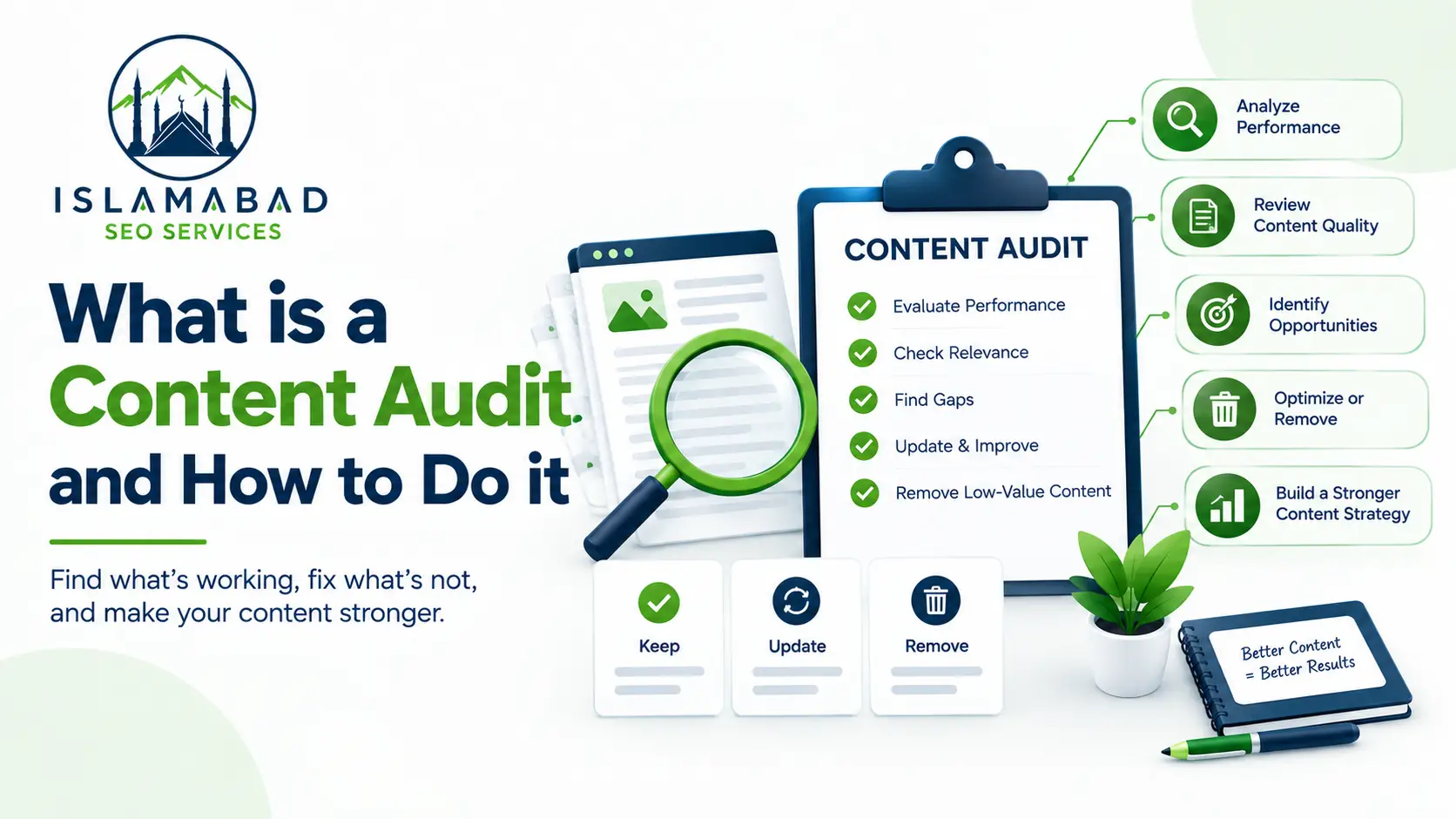
A content audit is a structured evaluation of your website content to identify pages that perform well, require updates, have lost relevance, or no longer support business objectives. A complete audit reviews content quality, organic visibility, user experience, conversions, accuracy, relevance, and optimization opportunities.
For Islamabad SEO Services, a useful audit goes beyond collecting URLs in a spreadsheet. You need a complete content inventory, trustworthy performance data, manual quality checks, and an action plan that connects every page with a defined search or business purpose. The process helps you decide which content to keep, update, merge, redirect, remove, or create.
A page-level review should connect search data with business context. This approach prevents you from treating every low-traffic URL as a problem and helps distinguish pages that need optimization from pages that serve a purpose for visitors and customers.
What Does a Content Audit Involve?
A content audit assesses existing digital assets against specific business, audience, and search objectives. The review can include blog posts, service pages, product pages, landing pages, guides, resources, videos, images, and other indexable website assets. For businesses targeting specific geographic markets, this can include content created to support local SEO.
Start by defining the reason for the audit. Your objective may involve increasing organic traffic, recovering lost rankings, generating more leads, eliminating outdated information, expanding topical coverage, or preparing a website for migration or redesign.
Every content decision should have supporting evidence. Organic traffic alone cannot determine a page’s value because a page with limited search visits can generate qualified leads, strengthen internal links, answer an important customer question, or support a commercial topic.
Why Should You Perform a Content Audit?
A content audit reveals where your existing content delivers value and where your content library consumes resources without a clear return. The findings help you direct SEO, editorial, design, and development resources toward pages with measurable strategic potential.
A well-executed audit can help you:
- Protect and expand pages that perform strongly.
- Detects pages with sustained performance declines.
- Find outdated facts, statistics, offers, links, and references.
- Identify overlapping pages that target similar search intent.
- Discover missing topics through keyword and competitor research.
- Find weak pages that need better structure, depth, evidence, or expertise.
- Strengthen internal connections between related topics and commercial pages.
- Remove redundant or low-value content with no defined purpose.
- Align website content with current audience needs, brand positioning, and business goals.
The outcome is a more controlled content strategy because every URL receives a documented role, measurable signals, and a defined next action.
When Should You Conduct a Content Audit?
The best time for a content audit is when changes in content performance, business priorities, search behavior, or website structure can affect existing pages. A redesign, migration, merger, rebrand, major search update, or substantial organic decline can justify an immediate review.
A mature website can undergo a comprehensive audit once or twice a year. Large websites and publishers can use rolling reviews by topic, service, category, or content format.
Start the process when you identify signs such as:
- Declining organic traffic or search visibility.
- Multiple URLs ranking for overlapping queries.
- Important pages receiving impressions but few clicks.
- Old pages containing inaccurate or expired information.
- New services or products without supporting content.
- Competitors covering relevant subjects missing from your website.
- Search-visible pages produce few meaningful actions.
- Several years of content without a documented maintenance process.
How Can You Perform a Content Audit?
To perform a content audit, build a complete inventory, collect performance information, assess each URL, classify the findings, and turn the findings into prioritized actions. A reliable workflow contains seven stages.
1. Build a Complete Content Inventory
A content inventory creates one central record for every important asset. Export URLs from your Content Management System (CMS), XML sitemap, analytics platform, and crawler, then combine the information into a master spreadsheet.
- URL
- Page title and H1
- Content type
- Topic and primary keyword
- Publication and update dates
- Organic clicks and impressions
- Organic traffic
- Leads or conversions
- Ranking information
- Indexation status
- Backlinks
- Internal links
- Content owner
- Recommended action
Screaming Frog can collect URL-level technical and on-page information at scale. Google Analytics 4 can provide traffic, engagement, and conversion data. Google Search Console can provide queries, clicks, impressions, indexing information, and search performance.
2. Establish Consistent Evaluation Criteria
Define evaluation standards before reviewing pages so every URL receives a consistent assessment. Criteria should reflect your content strategy, audience requirements, search intent, and commercial objectives.
Evaluate each page for:
- Audience relevance
- Information accuracy and freshness
- Search intent alignment
- Content quality and depth
- Organic search performance
- Conversion contribution
- Internal linking value
- Backlink profile
- Brand messaging consistency
- User experience and readability
Use clear labels such as strong, needs improvement, or critical. Consistent classifications make large audits easier to filter, compare, and prioritize.
3. Measure Content Performance
Measure each page against metrics that match the page’s purpose. A blog may depend on organic clicks, impressions, rankings, and assisted conversions, while a service page may depend more on qualified leads and conversion rate.
Use Google Search Console to review queries, impressions, clicks, Click-Through Rate (CTR), and average position. Use Google Analytics 4 to review users, sessions, engagement, and conversions. Compare performance with a relevant historical period rather than relying on one isolated date.
Watch for content decay when a page previously generated meaningful visibility or conversions but shows sustained deterioration. Causes can include outdated information, stronger competitors, changed search intent, technical problems, weak internal links, or insufficient topical depth.
4. Evaluate Content for SEO
An SEO content audit checks whether each page can satisfy relevant search intent and compete effectively within its topic. Review the primary topic, keyword targeting, title tag, meta description, headings, content structure, internal links, image optimization, canonical signals, indexability, and crawl issues.
Check whether separate pages target distinct search intents. Multiple URLs can create unnecessary topical overlap when several pages attempt to satisfy the same query without meaningful differentiation.
Compare underperforming pages with current search results. Review topic coverage, factual depth, originality, expertise, structure, evidence, media, and internal linking. Use competitor gaps to discover useful information for your audience instead of copying competitor wording.
5. Assess Content Quality and User Experience
Content quality depends on accuracy, usefulness, clarity, completeness, and suitability for the intended audience. Important pages require manual review because numerical metrics cannot reveal every quality issue.
Check whether each page:
- Answer the main question quickly.
- Uses descriptive headings and focused paragraphs.
- Provides current and accurate information.
- Supports significant claims with credible evidence.
- Matches the visitor’s research or buying stage.
- Uses tables, images, examples, or other formats when those formats improve comprehension.
- Gives visitors logical next steps without excessive promotion.
Review terminology, tone, author information, branding, and calls to action. Remove claims or details that no longer represent current services, products, policies, locations, or business priorities.
6. Find Content Gaps and Topic Overlap
A content gap analysis identifies important topics, questions, and search intents that your website does not adequately address. Use keyword research, customer questions, competitor coverage, sales feedback, and Search Console query data to identify missing subjects.
Not every related keyword needs a separate URL. Determine whether a missing topic belongs inside an existing page before creating new content. Consolidation can produce a stronger resource when several pages address closely related intent.
Classify content gaps by funnel stage. Informational pages can answer research questions, comparison content can support evaluation, and commercial pages can address services, products, pricing, or purchase decisions. Case studies can support the evaluation stage by providing evidence of previous results.
7. Assign an Action to Every Page
Every audited URL should receive one documented action based on evidence. Five practical outcomes cover most content decisions:
- Keep: retain pages with strong relevance, quality, and useful performance.
- Update: refresh facts, examples, links, structure, metadata, or search targeting.
- Consolidate: merge overlapping pages into a stronger resource and redirect redundant URLs.
- Remove: delete content with no strategic, search, user, or business value after reviewing alternatives.
- Create: publish a new resource when validated demand requires a dedicated page.
Record the reason behind every decision, then assign an owner and deadline. Review completed changes after publication to verify that the intended improvements reached the live website.
What Should a Content Audit Measure?
A content audit should measure performance, relevance, quality, search visibility, and business contribution at URL level. Useful measures include organic clicks, impressions, rankings, conversions, engagement, backlinks, freshness, content depth, indexability, internal links, and search-intent alignment.
Review these signals together because one metric rarely explains page performance. A traffic decline can result from competition, technical problems, outdated content, changed intent, or weak conversion alignment. Combined evidence helps you identify the actual issue.
How Does Artificial Intelligence Affect Content Audits?
Artificial Intelligence (AI) can accelerate content analysis, but strategic decisions still require human review. AI tools can summarize large URL sets, classify topics, detect similar content, identify outdated references, extract entities, and generate preliminary update recommendations.
An AI visibility audit can assess whether important pages provide direct answers, structured information, clear entities, supporting evidence, and broad topic coverage. These qualities help content remain understandable across traditional search and AI-driven discovery environments.
Do not automate deletion, consolidation, or major rewriting decisions without human validation. Business positioning, legal requirements, audience context, brand standards, factual accuracy, and conversion objectives require qualified review.
How Should You Prioritize Content Audit Findings?
Prioritize findings according to business value, search opportunity, audience impact, risk, and implementation effort. A page with declining visibility but strong lead value can require faster attention than a high-traffic page that contributes little to business objectives.
A practical four-level model includes:
- Critical: inaccurate, harmful, broken, duplicated, or strategically damaging content.
- High: important pages with significant opportunities for visibility or conversions.
- Medium: useful pages with clear optimization opportunities but limited immediate impact.
- Low: minor metadata, formatting, or routine maintenance issues.
Support every priority with documented evidence instead of relying on traffic volume alone.
What Are the Best Content Audit Practices?
The strongest audits combine quantitative data, qualitative review, SEO analysis, and business context. Follow these practices to keep the process actionable:
- Define objectives before collecting data.
- Maintain one standardized website inventory.
- Separate page quality from page performance.
- Evaluate search intent instead of focusing only on keywords.
- Validate important findings manually.
- Record the decision and reason for every URL.
- Assign owners and deadlines to approved actions.
- Monitor pages after updates go live.
- Schedule recurring content maintenance.
Content governance turns an individual audit into an ongoing operating process.
Final Thoughts
A content audit provides a data-backed framework for deciding which website pages to retain, improve, combine, remove, or create. The process begins with a complete inventory and continues through performance analysis, SEO evaluation, quality review, gap analysis, and action planning.
For Islamabad SEO Services, the objective is to build a content system where existing assets support organic visibility, user experience, conversions, and business priorities. A structured audit makes content optimization measurable and creates a repeatable process for long-term content management.
Frequently Asked Questions
What is the purpose of a content audit?
The purpose of a content audit is to evaluate existing content and determine which pages support business goals, search visibility, user needs, and conversions. The audit identifies content to keep, update, consolidate, remove, or create.
Can you provide some examples of content audits?
Examples include SEO content audits, website content audits, social media content audits, ecommerce content audits, and pre-migration audits. Each review examines content performance, quality, relevance, gaps, duplication, audience needs, required actions, and priorities.
How to do a content audit for social media?
To audit social media content, inventory posts by platform, format, topic, date, reach, engagement, clicks, and conversions. Compare performance against campaign goals, identify successful themes, remove weak patterns, and document content priorities for future publishing.
How often should you conduct a content audit?
Conduct a comprehensive content audit at least once or twice per year, with more frequent reviews for large, fast-changing websites. Use monthly performance monitoring and targeted quarterly reviews when content, products, regulations, or search demand change frequently.