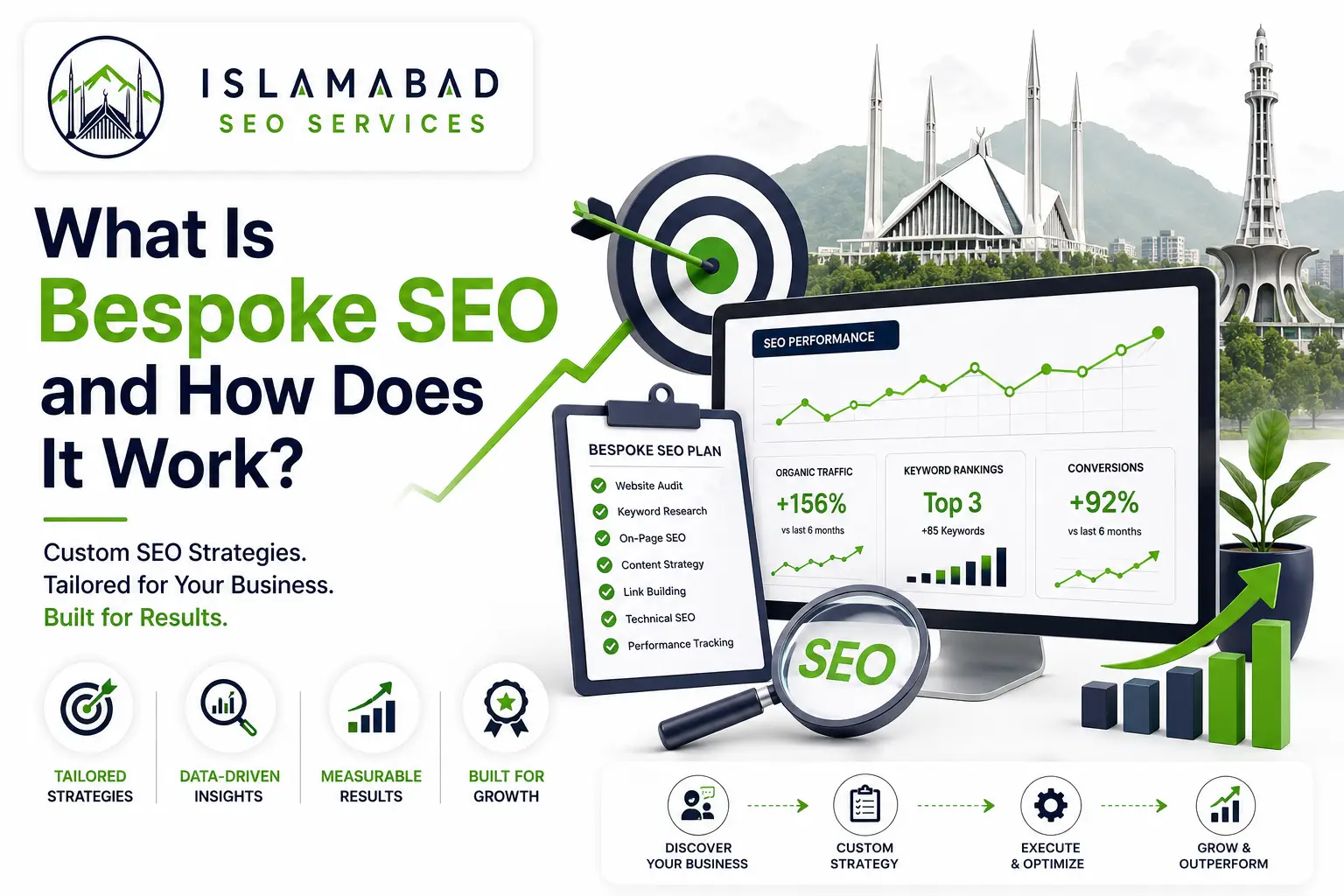
Bespoke SEO is a search engine optimization approach created specifically for the needs of an individual business. Instead of using a fixed list of SEO tasks, it considers factors such as business objectives, target customers, website structure, industry, competition, and available resources.
A tailored SEO campaign can include keyword research, technical optimization, competitor research, content development, on-page SEO, internal linking, and link building. The exact combination depends on where the biggest opportunities exist.
For instance, an online retailer may need to focus on product and category pages, while a local service provider may gain more value from service pages and location-specific searches.
Bespoke SEO and Traditional SEO: How Do They Compare?
Traditional SEO generally follows a familiar sequence of activities, such as keyword research, technical fixes, content creation, on-page optimization, and link building.
Bespoke SEO starts with the individual business and determines which activities deserve the most attention. The strategy can then change as the website, market, competition, or business goals evolve.
| Traditional SEO | Bespoke SEO |
| Often follows a predefined process | Developed around individual requirements |
| May prioritize keyword rankings | Considers intent and business outcomes |
| Uses commonly applied SEO tactics | Selects tactics according to research |
| Can rely on a fixed campaign structure | Can evolve as priorities change |
| Often emphasizes traffic | Connects SEO with leads and revenue |
What Goes Into a Bespoke SEO Strategy?
A customized SEO campaign can bring together several areas of optimization. The priorities depend on the website’s current condition and the results the business wants to achieve.
Personalized Keyword Research
Keyword research helps identify the language customers use when searching for information, products, and services.
Rather than selecting keywords based only on search volume, a tailored approach considers relevance, competition, search intent, and the likelihood of attracting valuable visitors. Keywords can then be mapped to appropriate pages across the website.
Competitor Research
Competitor analysis provides insight into how other websites are performing in organic search.
It can uncover keyword opportunities, missing topics, successful content formats, backlink sources, and areas where competitors may be leaving opportunities open.
Technical SEO
Technical optimization ensures that search engines can effectively access, crawl, understand, and index the website.
Depending on the site, this can involve improving website architecture, page speed, mobile usability, internal links, indexing, structured data, and other technical elements.
Content Planning
A customized content strategy focuses on the questions, problems, and topics that matter to your target audience.
Content can include blog articles, service pages, product descriptions, location pages, and landing pages. Each piece should have a clear purpose and align with relevant search intent.
On-Page SEO and Link Building
On-page optimization improves elements such as titles, headings, URLs, content, internal links, and other page signals.
Relevant link building can support the website’s authority and help important pages compete for more valuable search terms.
What Are the Advantages of Bespoke SEO?
A customized approach allows businesses to focus their SEO budget and resources on areas that are most relevant to them.
Key advantages include:
- More precise targeting: Focus on searches related to your actual customers and offerings.
- Higher-quality visitors: Reach users whose searches indicate genuine interest.
- Better prioritization: Concentrate on tasks with the strongest potential business impact.
- Adaptability: Change the strategy when your market or objectives change.
- Improved user experience: Many SEO improvements also make websites easier to use.
- Business-focused results: Connect organic search performance with enquiries, sales, and other outcomes.
What Services Can Bespoke SEO Include?
Because every website has different requirements, there is no single service list that applies to every bespoke SEO campaign.
Depending on the project, services may include:
- Technical SEO audits
- Website and on-page audits
- Customized keyword research
- Search intent analysis
- Competitor research
- Content planning and creation
- Internal linking
- Link building
- Schema markup
- Local SEO where appropriate
- Analytics and performance monitoring
The purpose is to combine the services that address the website’s most important SEO opportunities rather than adding unnecessary tasks.
How Is a Bespoke SEO Campaign Developed?
A successful strategy should begin with research and business understanding before implementation starts.
1. Set Business Goals and KPIs
Start by defining what SEO needs to accomplish. Depending on the business, this could mean generating more enquiries, increasing online purchases, improving organic revenue, or reaching a specific audience.
These goals provide a basis for measuring progress.
2. Review the Existing Website
A website audit helps identify technical problems, content weaknesses, indexing issues, site structure concerns, page speed problems, and opportunities for on-page improvements.
3. Learn About the Target Audience
The strategy needs to understand who the business wants to attract and what those people are looking for.
Search intent provides useful insight into whether users are looking for information, comparing options, or ready to take action.
4. Study Keywords and Competitors
Keyword research identifies relevant search opportunities, while competitor research provides context around difficulty and existing search results.
Using both helps establish which opportunities are worth pursuing.
5. Rank Priorities
SEO campaigns have limited time and resources, so not every recommendation needs to be implemented immediately.
Tasks can be prioritized according to potential impact, business importance, effort, competition, and available resources.
6. Execute and Refine the Strategy
Once changes are implemented, performance should be monitored regularly.
Data can reveal which pages and keywords are improving and where additional work is needed. The strategy can then be refined as the website and market develop.
How Can Bespoke SEO Support Business Goals?
SEO should contribute to the objectives of the business rather than operate separately from them.
An e-commerce company focused on increasing sales might prioritize transactional keywords, product categories, and pages that influence purchasing decisions.
A service provider looking for more enquiries may concentrate on high-intent service searches, local keywords, and landing pages designed to encourage contact.
Aligning SEO with business objectives helps ensure that optimization work has a clear commercial purpose.
Can Bespoke SEO Improve Traffic, Leads and Conversions?
A customized SEO strategy targets searches that are relevant to the products, services, and information a business provides.
When useful content and optimized landing pages match those searches, they can attract visitors who are more likely to engage with the business.
SEO can also improve what happens after visitors arrive. Better navigation, faster pages, clear calls to action, mobile-friendly design, and useful information can make it easier for users to complete an enquiry or purchase.
This creates a stronger connection between search visibility, website traffic, leads, and conversions.
Is Bespoke SEO Suitable for Your Business?
Bespoke SEO can be particularly valuable for businesses with specific growth objectives, competitive markets, specialized audiences, or more complex websites.
It may also be suitable if your company has multiple locations, offers several services, or has already invested in SEO without seeing the expected results.
Businesses that operate differently from their competitors can also benefit from a strategy that reflects their individual strengths and opportunities.
How to Find the Right Bespoke SEO Company
Choosing an SEO provider should involve more than comparing monthly prices.
Look for a company that:
- Takes time to understand your business
- Builds recommendations around your objectives
- Explains why specific SEO activities are needed
- Uses research and data to guide decisions
- Provides clear performance reports
- Measures meaningful business metrics
- Updates the strategy based on results
Avoid providers that promise guaranteed Google rankings or present exactly the same SEO plan to every client without considering their individual situation.
Mistakes to Avoid When Selecting SEO Services
Choosing an SEO service purely because it is inexpensive can be a costly mistake. A low-priced package may exclude important research, technical optimization, content work, or strategy.
Another common mistake is measuring SEO success only through rankings. Rankings are useful, but they do not always show whether the traffic is relevant or generating business.
Leads, conversions, sales, qualified traffic, and revenue can provide a more useful view of performance.
You should also be cautious about guaranteed ranking claims. Google results are influenced by competition, algorithms, content quality, website authority, and many other factors. No legitimate SEO company can guarantee a particular ranking.
Conclusion
Bespoke SEO takes a personalized approach to search engine optimization by considering a business’s goals, audience, website, industry, and competitors.
Instead of applying an identical checklist to every website, it identifies the areas with the greatest potential value and prioritizes them according to business needs.
As performance data becomes available, the strategy can be refined to respond to changing competition, search behaviour, and business priorities.
When keyword research, technical SEO, content, on-page optimization, and authority-building work together, a bespoke strategy can help businesses attract more relevant organic traffic and turn search visibility into meaningful growth.
Frequently Asked Questions
What Is Bespoke SEO?
Bespoke SEO is a personalized SEO strategy designed around the specific goals, audience, website, industry, and competition of a business.
Why Is It Called Bespoke SEO?
The word “bespoke” refers to something created for specific requirements. In SEO, it means developing an optimization strategy that is tailored to one particular business rather than using a standard package.
How Is Bespoke SEO Different From Traditional SEO?
Traditional SEO often uses a predefined set of activities, while bespoke SEO determines which tactics and priorities are most appropriate for the individual website and its objectives.
Is Bespoke SEO Better Than Standard SEO?
It can be particularly useful for businesses with competitive markets, specialized audiences, complex websites, or specific growth targets. The most suitable approach depends on the website and its objectives.
What Services Are Included in Bespoke SEO?
Services can include keyword research, technical SEO, competitor analysis, content strategy, on-page optimization, internal linking, link building, local SEO, schema markup, and performance tracking.
How Long Does Bespoke SEO Take to Show Results?
The timeframe varies depending on factors such as competition, website condition, industry, authority, and the amount of work being implemented. Some improvements can appear within a few months, while sustainable growth usually requires ongoing SEO.