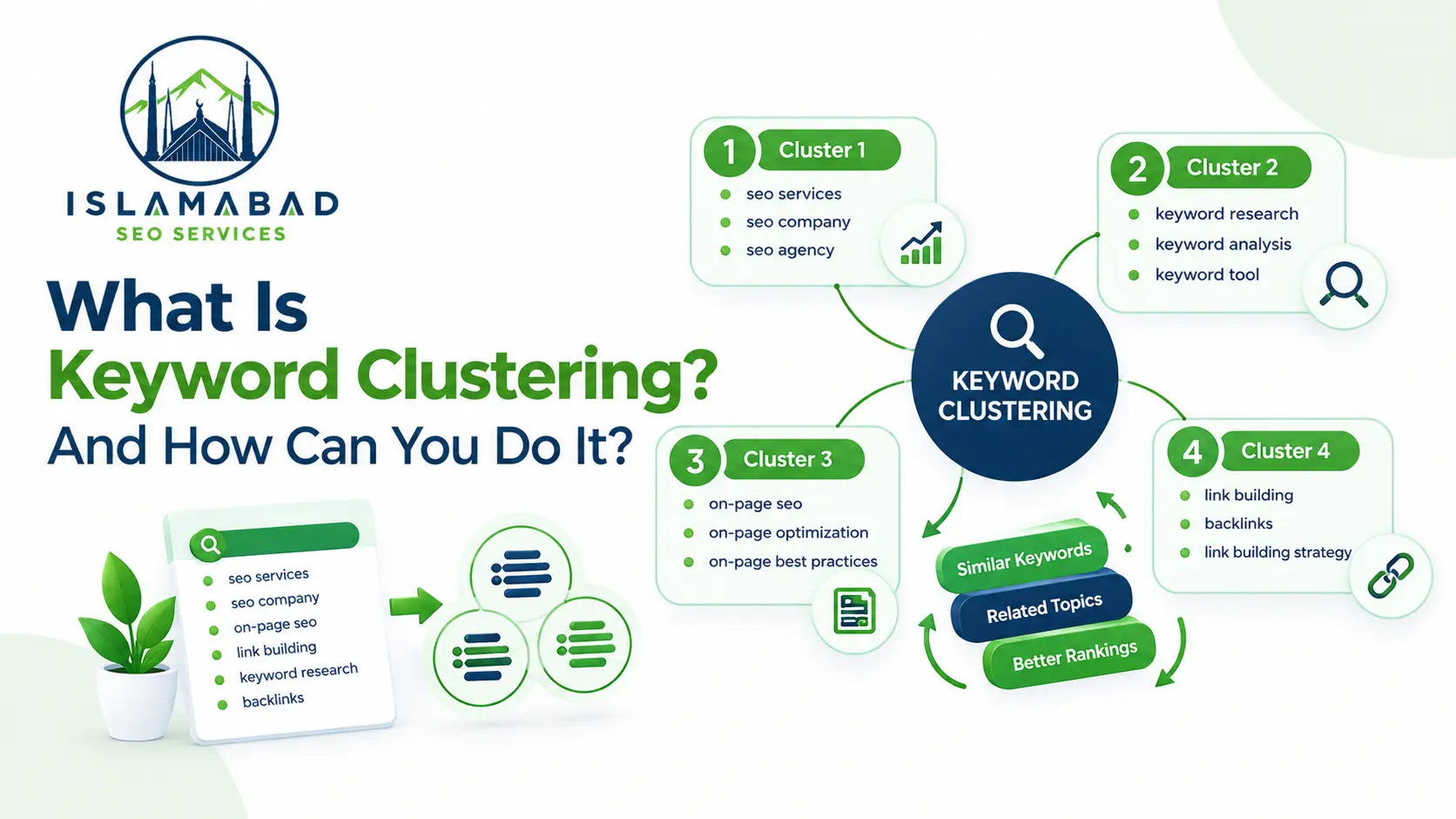
Keyword clustering is an SEO method used to group search queries that have similar intent, topic relevance, and ranking results. Rather than creating a separate page for every keyword variation, related searches are assigned to one relevant URL, allowing the page to address the broader search need.
For example, “best SEO agency,” “top SEO agency,” and “best SEO company” may form one keyword cluster when Google displays largely similar results for each query.
For businesses working with Islamabad SEO Services, keyword clustering makes content planning more organized because search demand can be structured around what users actually want instead of treating every keyword as a separate target.
Why Does Keyword Clustering Matter in SEO?
Keyword clustering helps assign related searches to the right pages while reducing unnecessary content duplication. A properly structured cluster can allow one page to rank for multiple closely related queries without forcing separate URLs to compete for the same intent.
Its key benefits include wider search visibility, stronger topical coverage, reduced cannibalization risk, clearer content briefs, improved internal linking, and more efficient content creation.
A keyword with low individual search volume can still be valuable when it forms part of a larger relevant cluster. However, clustering does not guarantee rankings. Content quality, relevance, technical SEO, authority, links, and user experience continue to influence organic performance.
How Does Keyword Clustering Work?
Keyword clustering combines keyword research, search intent analysis, semantic relationships, and Search Engine Results Pages (SERPs) analysis to determine whether different queries represent the same search requirement.
A practical workflow usually involves five steps: gathering keywords, removing irrelevant terms, identifying intent, comparing SERPs, and assigning each cluster to an appropriate URL.
Search intent should remain the main consideration. Search volume alone cannot tell you whether two keywords belong on the same page. A high-volume query may require a separate URL if users expect a different type of information, solution, or content format.
How to Build Keyword Clusters Step by Step
1. Create a Detailed Keyword Database
Begin keyword research with a seed term related to your service, product, topic, or audience problem. Expand the list using Google Autocomplete, People Also Ask, Related Searches, competitor websites, Google Keyword Planner, and professional SEO tools.
Record useful information such as the keyword, search volume, difficulty, intent, ranking URL, topic modifier, and business relevance.
Collect synonyms, long-tail phrases, questions, variations, and commercial searches before cleaning the list. Remove keywords related to different audiences, locations, products, services, or buying stages.
The objective is to build a keyword database based on genuine search demand rather than phrases that only appear relevant.
2. Identify the Search Intent
Search intent refers to the reason behind a user’s query. The four widely used categories are informational, navigational, commercial, and transactional.
Informational searches look for knowledge, such as “what is technical SEO.” Navigational searches are used to find a particular website or brand. Commercial searches help users compare available options, such as “best SEO services in Islamabad.” Transactional searches show an intention to take action, such as “hire SEO agency Islamabad.”
Keywords with clearly different purposes should not automatically be placed in the same cluster. Someone looking for an explanation may need a different page from someone searching for a service quotation.
SERP analysis can improve intent classification. Check the ranking titles, page formats, featured results, service pages, product pages, guides, and other result types shown by Google.
3. Analyze SERP Overlap
SERP overlap is a useful signal for deciding whether keywords should share a page. Search different keywords separately and compare the URLs appearing in the top results.
When several ranking URLs overlap, the searches often have related intent and may belong to the same cluster. When the results are substantially different, separate pages may provide a more accurate match.
For example, “SEO audit services” and “technical SEO audit agency” can have closely related commercial intent and overlapping results. However, “what is an SEO audit?” has an informational purpose and may be better served by a dedicated educational page.
Manual comparison is practical for smaller keyword lists. Larger databases can be processed with tools that measure ranking URL overlap automatically.
4. Select the Main Keyword
Each cluster should have a primary keyword that represents the page’s central subject and purpose. Choose it by considering relevance, intent, business value, search demand, and ranking feasibility.
Avoid selecting the highest-volume phrase automatically. A lower-volume keyword can be more suitable when it describes the page’s purpose more accurately.
Secondary keywords should expand the topic rather than create repetitive keyword usage. Related phrases can naturally appear in headings, paragraphs, examples, questions, and supporting sections.
5. Assign the Cluster to a URL
Keyword mapping connects each validated cluster with the most appropriate website URL. Before creating a new page, review the existing website structure.
If an existing page already satisfies the search intent, improve that page rather than publishing another article targeting the same requirement. If no suitable URL exists, create a new page with a defined purpose and primary keyword.
A keyword map can include the cluster name, primary keyword, secondary terms, search intent, target URL, content type, priority, and publishing status. This gives the website a clearer connection between search demand and site architecture.
Keyword Clusters vs Topic Clusters: What Is the Difference?
Keyword clusters group related queries that can generally be addressed by one page, while topic clusters organize several pages around a broader subject. They support different levels of SEO planning and can be used together.
For example, “local SEO services,” “local SEO agency,” and “local search optimization services” may form one keyword cluster when their intent and SERPs are substantially similar.
A topic cluster could include a local SEO pillar page supported by separate resources covering Google Business Profile optimization, citations, location pages, link building, and review management.
Keyword clustering focuses on page-level targeting, while topic clustering helps structure the wider website and its internal links.
What Is NLP Keyword Clustering?
NLP keyword clustering uses natural language processing to group search terms according to semantic relationships, entities, language patterns, and contextual meaning. It can identify relationships between phrases even when their wording is different.
This approach is especially useful for large websites containing thousands of keywords. However, semantic similarity alone should not determine the final URL structure.
Two phrases may refer to the same entity but still have different search intent and produce different Google results. Important clusters should therefore be checked against current SERPs before content is created or URLs are changed.
A strong workflow combines NLP with SERP analysis. NLP helps discover relationships between keywords, while search results help confirm whether those relationships should be covered by one page or several pages.
How Should You Prioritize Keyword Clusters?
Keyword clusters can be prioritized using business relevance, search intent, demand, competition, existing authority, conversion potential, and content gaps.
Give attention to clusters that closely relate to your products or services, have meaningful search demand, offer realistic ranking opportunities, and support clear business objectives.
Do not prioritize a cluster simply because a keyword tool reports high search volume. Large amounts of irrelevant traffic may consume content resources without generating qualified enquiries, leads, or sales.
How Do You Create Content From a Keyword Cluster?
Create one focused page that thoroughly satisfies the shared search intent. Use the primary keyword to define the page topic and add secondary terms only when they contribute useful information.
Structure the content around relevant questions, subtopics, entities, examples, comparisons, and decision points to optimize website content for SEO.
Avoid forcing every keyword into headings. Similar variations can naturally fit into the body content, while substantially different questions may deserve their own sections.
Use internal links to connect the page with relevant supporting resources and commercial pages. Anchor text should accurately describe the destination instead of repeatedly using the same exact-match phrase.
How Can Keyword Clustering Reduce Cannibalization?
Keyword clustering can reduce keyword cannibalization by establishing which URL should address a particular search intent. When multiple pages target the same requirement, ranking signals can become divided and Google may rank a different URL from the one you intended.
Use Google Search Console to identify queries where multiple URLs receive impressions, then compare the purpose and content of those pages.
If two pages substantially overlap, consolidation may be appropriate. Redirect an unnecessary URL when its content should permanently move to another page. Canonicalization can help with duplicate or near-duplicate pages. When pages serve different purposes, improve their content targeting and strengthen relevant internal links instead.
Do not merge pages merely because their keywords look similar. Intent, backlinks, traffic, conversions, content purpose, and historical performance should all be considered.
How Can AI Tools Assist With Keyword Clustering?
AI tools can speed up keyword clustering by processing large datasets, identifying semantic relationships, classifying search intent, and suggesting groups.
However, AI-generated clusters still require human review. Use AI for initial discovery and organization as part of a broader SEO content strategy, then validate important groups against live SERPs, business goals, and the existing website structure.
Automated tools can be particularly useful for ecommerce stores, publishers, and service websites with extensive keyword databases. However, AI may incorrectly combine queries that have different search purposes.
Treat automated clustering as a starting point rather than the final SEO decision.
How Do You Measure Keyword Cluster Performance?
Measure cluster performance at both the page and query levels. Google Search Console provides data such as impressions, clicks, click-through rate, average position, pages, and queries, allowing you to evaluate how a URL performs across related searches.
Look beyond the primary keyword and check whether the page gains visibility for several relevant queries. New queries appearing after publication can also reveal content gaps worth addressing.
For commercial clusters, monitor conversions as well as traffic. A page with fewer visits can still generate meaningful business value when its visitors have stronger purchase or enquiry intent.
Review important clusters regularly because search intent, competitors, services, products, and business priorities can change.
Common Keyword Clustering Errors
Most clustering mistakes happen when keywords are grouped according to similar wording rather than actual search intent.
Avoid the following:
- Creating separate pages for minor variations with identical intent.
- Combining informational and transactional searches on one page.
- Accepting AI-generated clusters without checking SERPs.
- Selecting primary keywords based only on search volume.
- Ignoring existing URLs before publishing new pages.
- Treating semantic similarity as proof of identical intent.
- Neglecting internal links between related pages.
- Redirecting or deleting pages without reviewing their performance.
A useful keyword cluster is more than a collection of similar phrases. It represents a clear search need with a logical page destination.
How Can I Cluster Keywords for SEO?
You can cluster keywords by collecting related searches, identifying their intent, comparing SERP overlap, choosing a primary keyword, and assigning each group to an appropriate URL. NLP tools can speed up the process, but important clusters should still be validated against current search results and business relevance.
What Are the Four Types of Search Intent?
The four common search intent categories are informational, navigational, commercial, and transactional. Informational searches seek knowledge, navigational searches look for a particular destination, commercial searches compare options, and transactional searches indicate an intended action such as purchasing, booking, or making an inquiry.
Why Is Keyword Clustering Important for SEO?
Keyword clustering helps connect related searches with the appropriate page, improve topical coverage, reduce unnecessary duplication, and make content planning more efficient. A validated cluster allows one page to address multiple related searches while separate URLs handle genuinely different intents.
Can Keyword Clustering Help Resolve Keyword Cannibalization?
Yes. Keyword clustering can help address cannibalization by identifying the preferred URL for a shared search intent. Depending on the situation, overlapping pages may be consolidated, targets refined, unnecessary URLs redirected, or internal linking improved after reviewing intent, rankings, traffic, backlinks, and conversions.
How Does Keyword Clustering Help With AI Search Visibility?
Keyword clustering can support AI search visibility by organizing content around related entities, questions, and search intents. Well-structured pages and connected topic groups provide clearer context for systems that retrieve, summarize, and cite information when responding to complex searches.