Search engines have become much better at understanding the meaning behind searches. Instead of looking only for exact keyword matches, they analyze context, topics, relationships, and the things mentioned within content.
This shift has made entities in SEO increasingly important. Entities help search engines recognize specific people, businesses, products, locations, organizations, and ideas. Understanding how entities work can help you create content that is easier for search engines to interpret and more useful for readers.
Understanding the Meaning of an Entity in SEO
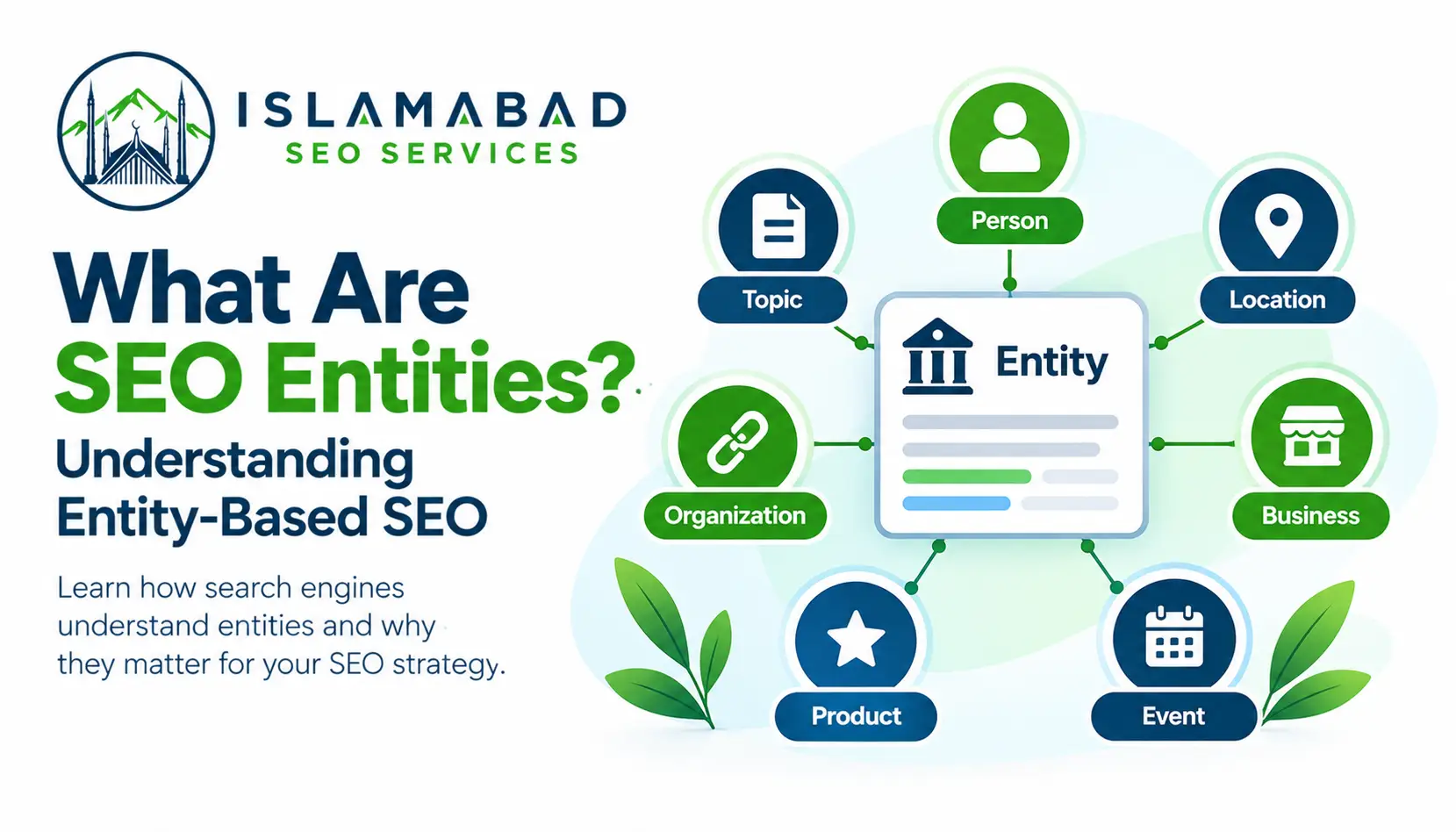
An entity is a clearly identifiable thing that exists as a distinct person, place, object, organization, or concept.
Common examples include:
- Pakistan
- WordPress
- Burj Khalifa
- Digital Marketing
- Cristiano Ronaldo
The important difference is that an entity represents something specific, rather than simply being a word or phrase.
For example, “Jordan” could refer to the country, the basketball player Michael Jordan, or the Nike Jordan brand. Search engines use surrounding information to determine which entity is being discussed.
How Google Recognizes and Connects Entities
Search engines use natural language processing, machine learning, structured information, and large databases to understand entities.
Google’s Knowledge Graph is one system that helps connect entities with facts and relationships.
For example:
Google → Company → Search Engine → Google Search → Online Search
These connections allow search engines to build a better understanding of the subject being discussed.
When your content provides clear information about a topic and its related entities, search engines have more context for interpreting the page.
Why Entities Are Valuable for SEO
Entity-focused SEO helps search engines move beyond individual keywords and understand the overall subject of a webpage.
A page about website development, for example, may naturally discuss WordPress, HTML, CSS, JavaScript, hosting, responsive design, and user experience.
These related entities help establish what the page is about.
Understanding Search Meaning
Modern search is heavily focused on understanding what a user actually wants.
Consider these searches:
- “best laptops for students”
- “laptops suitable for university students”
The wording is different, but the underlying topic is closely related.
Entities and semantic relationships help search engines connect queries that have similar meanings.
Building Knowledge Graph Relationships
The Knowledge Graph helps Google understand how different entities relate to one another.
For example:
Nike → Brand → Sportswear → Running Shoes → Athletes
A website can support this understanding by providing accurate information about its business, products, services, people, and areas of expertise.
The objective is not to manipulate the Knowledge Graph. Instead, focus on making your website information clear, accurate, and consistent.
Supporting AI Search
AI-powered search depends heavily on context and relationships. AI systems need to understand how different concepts connect before they can generate useful responses.
For example, content about eCommerce SEO could discuss Shopify, WooCommerce, product pages, reviews, product schema, search intent, and conversion optimization.
These connections provide broader context around the main subject.
Strengthening Topical Authority
Entity relationships can contribute to stronger topical coverage.
A website focused on SEO might publish detailed content about:
- Keyword research
- Technical SEO
- Local SEO
- On-page optimization
- Link building
- Content marketing
Covering related subjects helps establish a broader understanding of the website’s expertise.
Examples of Entities You May Find in Content
Entities are not limited to businesses or famous people. They can appear in almost any industry.
People, Brands, and Organizations
Examples include:
- Apple
- Adobe
- Elon Musk
- Stanford University
- Nike
Each has specific characteristics and connections with other entities.
For example, Apple can be associated with iPhone, iPad, macOS, iOS, and other technology products.
Products and Services
Products and services can also represent identifiable entities.
Examples include:
- iPhone
- Adobe Photoshop
- WordPress
- Web design
- Search engine optimization
- Cloud hosting
When discussing these subjects, providing useful details helps establish their meaning and relevance.
Geographic Entities
Places are another important category of entities.
Examples include:
- Australia
- Melbourne
- Karachi
- London
- Eiffel Tower
- New York City
Geographic entities are especially relevant when creating local or location-based content.
Events and Ideas
Entities can also represent events, subjects, and abstract concepts.
Examples include:
- FIFA World Cup
- Black Friday
- Artificial Intelligence
- Digital Marketing
- Search Engine Optimization
These entities help provide additional context when they are genuinely related to the main topic.
How to Discover Important Entities for a Topic
Finding relevant entities starts with understanding the main subject of your page.
Identify the people, brands, products, services, locations, concepts, and related subjects that help explain the topic.
Consider questions such as:
- What is the primary entity?
- Which entities are closely connected to it?
- What related information would readers expect?
- Which entities appear in high-quality search results?
- What supporting concepts help explain the topic?
Review Your Existing Content
Read your content carefully and identify important names, organizations, products, locations, and concepts.
For example:
“Google Search Console provides information about a website’s search performance.”
Relevant entities include Google Search Console, Google, website, and search performance.
This process can reveal entities that are already present and show where additional context may be useful.
Examine Google’s Search Results
Search for your main topic and study the results.
Pay attention to:
- People Also Ask
- Related searches
- Knowledge Panels
- Search result topics
- Commonly mentioned brands
- Competitor pages
This research can help you discover related entities that users and search engines associate with the topic.
Only use entities that add real value to your content.
Practical Entity SEO Techniques
Optimizing for entities does not mean adding as many names and concepts as possible. The goal is to create useful and logical relationships throughout your website.
Identify Your Primary Entities
Start by listing the entities most important to your business.
These might include:
- Company name
- Products
- Services
- Locations
- Industry
- Team members
- Main topics
Make sure these details are clearly presented on appropriate pages.
Develop Topic Clusters
Organize your content around broad topics and their supporting subjects.
For example, an SEO website could have a main SEO guide supported by pages covering keyword research, technical SEO, local SEO, content optimization, and link building.
This structure gives search engines more information about your topical expertise.
Create Strong Internal Connections
Internal links connect related pages and help search engines understand the structure of your website. A well-organized site should work alongside technical elements such as XML sitemaps to help search engines discover and understand important pages.
A page about local SEO might link to related resources about Google Business Profile, local keywords, citations, reviews, and location pages.
Use descriptive and natural anchor text so the connection between pages is clear.
Use Appropriate Structured Data
Structured data provides additional information about webpages and the entities they contain.
Depending on the page, useful schema types may include:
- Organization
- Person
- Product
- Article
- LocalBusiness
- Breadcrumb
Always use schema accurately and only mark up information that is supported by the page.
Explain Entity Relationships
Mention related entities when they help readers understand the main subject.
For example, an article about WordPress SEO could naturally discuss plugins, XML sitemaps, metadata, internal links, crawling, indexing, and page speed.
These relationships create a clearer topical picture without requiring keyword or entity stuffing.
Keep Important Information Consistent
Business information should remain consistent across your website and trusted external platforms.
This includes your:
- Business name
- Address
- Phone number
- Website
- Services
- Locations
Consistent information helps reinforce the connection between your brand and its online mentions.
Build a Recognizable Brand Entity
Make your brand easy to understand by providing clear information on your homepage, About page, author pages, business listings, and relevant social profiles.
Where appropriate, use Organization or other suitable structured data to provide additional context.
Entity SEO Guidelines to Follow
A strong entity SEO strategy should follow a few basic principles:
- Focus on meaning and context.
- Use entities naturally within content.
- Cover related topics thoroughly.
- Explain meaningful relationships.
- Create useful internal links.
- Apply relevant structured data.
- Keep business information accurate.
- Match content with search intent.
- Use trustworthy information.
- Write primarily for users.
The purpose of entity optimization is to improve understanding, not to make content more complicated.
Entity SEO Problems to Avoid
Poor implementation can reduce the quality of your content.
Entity stuffing: Repeatedly adding entity names can make content sound forced.
Unrelated entities: Mentioning popular brands or topics without a genuine connection does not improve SEO.
Conflicting information: Different business details across online sources can create uncertainty about your brand.
Ignoring fundamentals: Entity SEO does not replace technical optimization, quality content, backlinks, good UX, or search intent.
Use entities as one part of a complete SEO strategy.
How to Monitor Entity SEO Results
Entity SEO does not have one dedicated performance score. Instead, evaluate several SEO and visibility signals.
Useful metrics include:
- Organic traffic
- Search impressions
- Keyword rankings
- Non-branded searches
- Brand visibility
- Search Console clicks
- Topic cluster performance
- Visibility in AI-generated search results
Look for signs that your website is becoming more visible for related searches and that your brand is being associated with the topics you cover.
The Future of Entity-Based SEO
Search engines are becoming increasingly focused on understanding meaning instead of simply matching words.
AI search is accelerating this shift by using context, relationships, and entities to produce answers.
Keywords remain an important part of SEO, but they should not be treated as isolated phrases. Strong content connects the main topic with relevant entities, answers user questions, demonstrates expertise, and provides useful information.
In simple terms, keywords show what users type into search engines, while entities help search engines understand the people, places, products, brands, and concepts behind those searches.
Frequently Asked Questions
1. What is an entity in SEO?
An entity is a unique and identifiable person, place, brand, product, organization, or concept. Search engines use entities to understand the meaning and context behind content.
2. Why are entities important for SEO?
Entities help search engines understand topics, relationships, and search intent. Optimizing for entities can improve semantic relevance, topical authority, and visibility in modern search results.
3. What is the difference between an entity and a keyword?
A keyword is a word or phrase people type into search engines. An entity represents the actual person, place, product, brand, or concept behind that term. Entities provide search engines with deeper context.
4. How do search engines identify entities?
Search engines identify entities by analyzing content, context, relationships, structured data, and information from trusted knowledge bases. This helps them distinguish between entities with similar names or meanings.
5. How can I optimize my website for entities?
Map your core entities, create comprehensive topic clusters, use internal links, add relevant schema markup, maintain consistent business information, and connect related entities throughout your content.